


 Text Annotation
 Audio Annotation
 Image & Video Annotation
 Generative AI, LLM, RAG Data Structuring
 AI Model Development
 In-House Support
 For the medical industry
 For the automotive industry
 For the IT industry
 For the manufacturing industry



The dream technology represented by ChatGPT allows you to perform various tasks by conversing with machines just like you would with a person. Among these, models known as LLMs (Large Language Models) learn from large-scale language datasets and respond to user questions and prompts in natural language, such as spoken language, with astonishing accuracy. By leveraging their capabilities to handle various tasks such as document generation, summarization, analysis, and code creation, businesses can accelerate operational efficiency, productivity improvement, and value creation. As a result, many companies are advancing their efforts to utilize LLMs. In this article, we will clearly explain how to effectively utilize LLMs in business, using case studies as examples.
- Table of Contents
1. What is LLM?
LLM stands for "Large Language Model." This model demonstrates excellent capabilities in various natural language processing tasks by learning from a vast amount of text data, such as content from the internet. Examples include ChatGPT and Gemini.
LLMs are based on neural networks and excel at considering the context of the input text to predict the subsequent words or phrases. For example, if you input something like, "Briefly tell me about the history of AI*Figure 1," it can gather words related to the history of AI based on its training and output a sentence constructed in a natural order. This mechanism allows for various applications, including text generation, translation, summarization, and analysis.
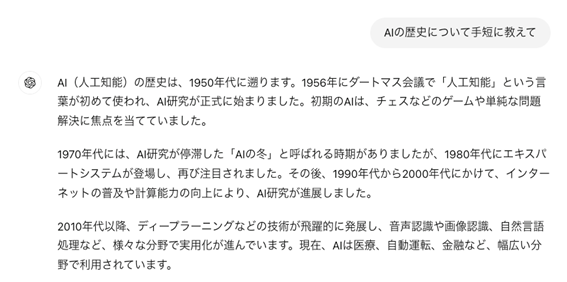
Figure 1 (Output from GPT-4o)
By applying this capability, it will be possible to utilize various documents that are generated daily in business, such as email and content creation tasks, as well as various reports and meeting minutes that are dispersed and accumulated within the company as knowledge. In the next chapter, we will introduce examples of business applications using LLM.
Major LLM Comparison Table (As of 2026)
Currently, multiple LLM services are offered, each with different areas of expertise and characteristics. A simple comparison of the features of representative LLMs is as follows.
| Services | Provider Companies | Main Features | Areas of Expertise | Translation Fee Estimate |
|---|---|---|---|---|
| ChatGPT | OpenAI | High text generation capability and wide range of applications | Document creation, summarization, brainstorming, code generation | Free plan available / Paid version around $20 per month |
| Gemini | Strong integration with Google services | Information retrieval, document organization, Google Workspace utilization | Free plan available / Paid version available | |
| Claude | Anthropic | Skilled at processing long texts and generating natural sentences | Meeting minutes organization, long text summarization, business document creation | Free plan available / Paid version available |
| Copilot | Microsoft | High compatibility with Microsoft products | Office work support, code assistance | May be included in Microsoft product contracts |
When utilizing LLMs in a company, it is important to select not only based on "which LLM is superior" but also from the perspective of "whether it is compatible with the company's own business."
Reference URL: [2026 Edition] Thorough Comparison of Major LLMs: A Guide to Using ChatGPT, Perplexity, Grok, and Gemini
2. Examples of Use in Business
●Chatbot
Before LLM, there were chatbots that utilized AI, but they were designed to operate based on pre-defined scenarios and rules, making it difficult to respond flexibly to a wide range of customer inquiries. With LLM, it becomes possible to understand various questions. Additionally, it can comprehend free-form text, such as conversational language, and texts that may contain minor typos. Furthermore, LLM can understand chat history and engage in dialogue, allowing it to answer complex questions that are difficult to address in a simple Q&A format. By applying this, it is also possible to customize responses for each user by referencing their individual past inquiries, which was challenging for traditional chatbots.
By utilizing LLM in this way, it becomes possible to respond broadly to various questions and inquiries from customers, which is expected to enhance user experience and satisfaction. Additionally, it is anticipated that the burden on the support team will be significantly reduced.
●Knowledge Management
Knowledge management is the process of effectively collecting, sharing, and utilizing knowledge within a company. This allows the unique experiences and skills of individual employees to spread throughout the organization, leading to increased productivity and the promotion of value creation. Much of this knowledge is accumulated within the company in various text-based documents. However, efficiently utilizing these vast amounts of documents is not an easy task. To extract what information is contained in the documents, one must take the time to open, read, and summarize them. Doing this for a large volume of documents often requires a significant amount of resources, making it impractical in many cases.
LLMs excel at automatically analyzing large volumes of documents and reports, extracting and classifying highly relevant information. Even with vast amounts of documentation, they can automatically organize and utilize the knowledge buried within, making them a powerful tool for streamlining knowledge management.
Reference URL: Takenaka Corporation, Construction Industry Knowledge Search "Digital Master Carpenter" Built with AI "Amazon Bedrock"
●Marketing and Market Research
The data held by companies contains important insights hidden in customer feedback received through surveys and customer support, as well as sales reports that capture market trends. By leveraging the text comprehension and analytical capabilities of LLMs, businesses can utilize this information for their strategies. For example, text analysis of customer reviews and feedback can help understand customer emotions and trends, aiding in the improvement of product development and marketing strategies.
Reference URL: NEC develops technology for planning marketing strategies using generative AI
3. FAQ
Q1. What is the difference between LLM and generative AI?
Generative AI refers to AI technologies that generate text, images, audio, and more.
Among these, LLMs are AI models specialized in handling "text." Text generation AIs like ChatGPT operate by utilizing LLMs.
Q2. Is it safe to input internal company information into LLMs like ChatGPT?
When using LLMs, it is important to confirm in advance how the input information will be handled.
Depending on the service, input data may be used to improve or train the AI model. On the other hand, some enterprise plans offer opt-out settings that prevent input data from being used for training, as well as enhanced security features.
Therefore, when handling confidential or personal information, it is important to review the terms of service and security policies and establish appropriate operational rules.
Q3. If we implement LLM, can we immediately improve business operations?
LLM is a very powerful technology, but simply implementing it does not produce immediate results.
Organizing internal data, designing prompts tailored to the use case, and integrating them into business workflows are important. Especially in corporate use, data preparation and structuring are key factors that determine success.
4. Summary
We have introduced examples of utilizing LLM in business up to this point. Within companies, there is likely a large amount of text data that has either been unused or has not been utilized due to a lack of means to do so. As we have introduced, by leveraging LLM for this data, we can expect further operational efficiency, productivity improvement, and value creation in business. However, simply implementing LLM and feeding it text data does not guarantee immediate results. While LLM can indeed demonstrate excellent capabilities, if you require the level of accuracy needed in business, it may be necessary to organize the data.
This is because regular text data is mostly unstructured data that does not have a certain set of rules or structure. LLMs excel at handling unstructured data, but there are challenges such as hallucinations (the generation of false information that does not correspond to facts) in terms of accuracy. Therefore, to utilize LLMs, it is necessary to structure unstructured data. In most cases, this work needs to be done manually, and if a company handles a vast amount of data on its own, it may hinder its core business. There are many experienced outsourcing vendors for creating structured data, so it is recommended to consider consulting these outsourcing vendors while advancing the implementation of LLMs.
5. Human Science Teacher Data Creation and LLM RAG Data Structuring Outsourcing Service
Over 48 million pieces of training data created
At Human Science, we are involved in AI model development projects across various industries, starting with natural language processing, including medical support, automotive, IT, manufacturing, and construction. Through direct transactions with many companies, including GAFAM, we have provided over 48 million high-quality training data. We handle a wide range of training data creation, data labeling, and data structuring, from small-scale projects to long-term large projects with a team of 150 annotators, regardless of the industry.
Resource management without crowdsourcing
At Human Science, we do not use crowdsourcing. Instead, projects are handled by personnel who are contracted with us directly. Based on a solid understanding of each member's practical experience and their evaluations from previous projects, we form teams that can deliver maximum performance.
Generative AI LLM Dataset Creation and Structuring, Also Supporting "Manual Creation and Maintenance Optimized for AI"
We support not only labeling for data organization and training data creation for identification-based AI, but also the structuring of document data for generative AI and LLM RAG construction. Since our founding, manual production has been our main business and service, and we now also provide support for "organizing business knowledge and manualization toward future generative AI and RAG introduction and utilization." We offer optimal solutions leveraging our unique expertise deeply familiar with the structure of various documents.
Secure room available on-site
Within our Shinjuku office at Human Science, we have secure rooms that meet ISMS standards. Therefore, we can guarantee security, even for projects that include highly confidential data. We consider the preservation of confidentiality to be extremely important for all projects. When working remotely as well, our information security management system has received high praise from clients, because not only do we implement hardware measures, we continuously provide security training to our personnel.
In-house Support
We provide staffing services for annotation-experienced personnel and project managers tailored to your tasks and situation. It is also possible to organize a team stationed at your site. Additionally, we support the training of your operators and project managers, assist in selecting tools suited to your circumstances, and help build optimal processes such as automation and work methods to improve quality and productivity. We are here to support your challenges related to annotation and data labeling.























































 Return to the top of the page
 +81 35-321-3111[Tokyo Headquarters]
  Contact Us
 Request for Information
 TOP
TOP SITE MENU