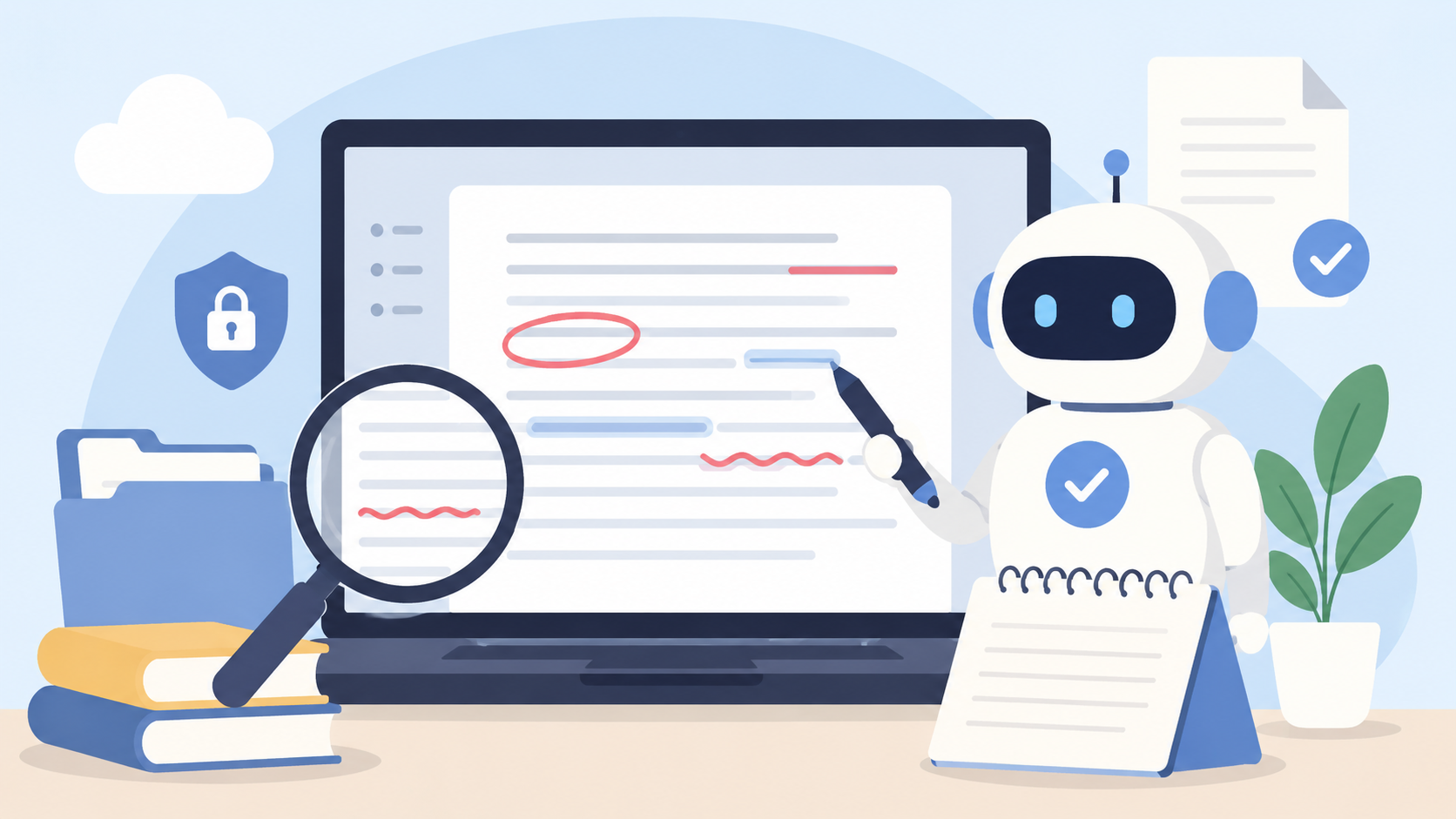

01. Background of the Growing Attention to AI Proofreading and AI Writing Tools
1-1. Increasing Demand for Work Efficiency
Although tasks such as creating manuals, issuing internal notices, and producing web content occur routinely, many companies have left these areas untouched as they are difficult to streamline. In this context, it is natural that expectations for AI tools as a means to improve efficiency in document-related tasks are rising. In particular, "automation of proofreading" and "AI-assisted writing support" are themes that can significantly reduce labor and are relatively easy to consider implementing.
1-2. The Spread of Generative AI and Changes in Writing
Since 2023, the rapid spread of generative AI, including ChatGPT, has made "having AI write text" and "having AI check text" more familiar. On the other hand, it is not uncommon for generative AI outputs to "appear plausible at first glance but be inaccurate." When using it for business purposes, a new challenge of quality control has emerged. It is important to correctly recognize that "becoming usable" and "being reliable as business quality" are separate issues.
1-3. Challenges of Traditional Proofreading and Review Tasks
Behind the growing expectations for AI tools lie structural challenges inherent in traditional proofreading and review tasks. For example, many organizations share the problem of relying on the experience and intuition of veteran staff for proofreading over many years, without having clearly documented standards. As a result, the accuracy of checks varies depending on the person in charge, leading to instability in the final quality of documents. Additionally, there are cases where notation rules are not unified within the organization, causing inconsistencies in notation across different documents. Another issue is that multiple rounds of review occur for a single document, which extends the time required until release.
02. What Are the Differences Between AI Proofreading and AI Writing?
AI proofreading and AI writing are concepts that are often confused, but their purposes and functions are clearly different. To choose the appropriate tool, it is essential to first correctly understand this difference.
2-1. The Role of AI Proofreading Tools
AI proofreading tools are tools designed to detect and correct typographical errors, inconsistencies in notation, grammatical mistakes, and inappropriate expressions in existing text. In other words, they serve as entities responsible for "text checking and quality control," and are utilized in situations such as quality verification of manuals, pre-publication reviews of web content, and final checks of documents intended for external use.
2-2. The Role of AI Writing Tools
AI writing tools are tools that generate and suggest text itself when you input a theme or keywords. They support the process of creating text from scratch and can significantly reduce the time required to draft. Their use is expanding for creating first drafts of blog articles, email templates, FAQs, product descriptions, and more.
2-3. Reasons Why Confusing the Two Often Leads to Failure
Some people might think, "If AI writes the text, proofreading will no longer be necessary." However, in reality, it is not uncommon for AI-generated text to contain factual inaccuracies, inconsistent notation, stylistic inconsistencies, and discrepancies with company rules.
Proofreading is also necessary for AI writing outputs. In fact, precisely because the text is written by AI, it is essential to have a process where humans or AI proofreading tools verify whether there are any issues against the organization's quality standards. If this distinction is left unclear when introducing tools, it will lead to the result of "using them but not improving quality."
03. Key Points When Choosing AI Proofreading and AI Writing Tools
When selecting a tool, it is important to assess not only the richness of features and price but also its compatibility with your company's actual business operations. Here, we explain four particularly important perspectives.
3-1. Ability to Comply with Proofreading Standards and Notation Rules
A generic grammar check function alone cannot fully support quality control at the business level. In addition to the general rules for distinguishing between kanji and hiragana and terminology unification, whether the tool can be configured with the company’s own regulations and style rules is the most important point when selecting a tool.
3-2. Support for Specialized Terminology and Industry-Specific Adaptation
Industries such as manufacturing, IT, healthcare, and finance each have their own unique terms and expressions. Since general-purpose AI may mistakenly correct specialized terminology, it is essential to check the extent of dictionary registration features and customization flexibility when selecting a tool.
3-3. Security and Confidential Information Management
Corporate documents often contain confidential information, so it is especially important to carefully verify the data handling policies when using cloud-based tools. Before implementation, a security check is essential to confirm whether the input data will be used for AI training, where the data is stored, and whether it aligns with your company's security policies.
3-4. Ease of Integration into Business Workflows
No matter how high-performing a tool is, if it is difficult to integrate into existing business workflows, it will not be adopted on the ground. Considering operational compatibility in advance—such as integration with writing tools like Microsoft Word, integration with CMS and document management tools, availability of APIs, and permission management for team use—leads to smooth adoption after implementation.
04. [By Type] 10 Recommended Tools Strong in AI Proofreading and AI Writing for Text
From here, we will introduce a total of 10 tools and services classified into five types that can be utilized for AI proofreading and AI writing. We have organized the features and the types of companies they are suited for, so please refer to the category closest to your company's challenges.
4-1.① General-purpose Generative AI Type (Versatile Use through Prompt Design)
This is a method of utilizing general-purpose generative AI for proofreading and writing. Its greatest strength is flexibility, as it can handle various uses such as proofreading, text generation, summarization, and translation depending on the design of the prompt (instruction sentence).
This category is suitable for companies that have personnel knowledgeable in prompt design and AI utilization within the organization. It can be a strong option if you want to flexibly apply AI to multiple tasks. However, since the output varies greatly depending on the quality of the prompts, establishing prompt templates and formulating internal operational rules are essential to create a state where "anyone can achieve the same results."
・OpenAI ChatGPT is a representative name for generative AI. It has a high ability to generate natural sentences and can be used for checking inconsistencies in notation and unifying writing styles by giving specific proofreading instructions. The latest models have improved reasoning capabilities, enabling them to propose corrections that understand complex contexts.
・Anthropic Claude is a generative AI strong in handling long texts and well-suited for proofreading tasks involving large volumes of documents such as manuals and technical documents. Its design philosophy emphasizes safety, and the ability to handle long documents while maintaining context is a significant advantage for companies that regularly deal with business documents.
・Microsoft 365 Copilot is based on the latest models from OpenAI and Anthropic, while also providing advanced security and data protection (commercial data protection) as standard, meeting the demands of enterprises. It guarantees that the input data will not be used for model training, allowing safe use even in business scenarios handling confidential information. Furthermore, it excels at generating responses by referencing the latest information on the web, strongly supporting writing tasks that require fact-checking.
4-2.② Proofreading Specialized Tools (Strong in Automatic Detection of Inconsistent Notation and Typographical Errors)
These tools are developed specifically for proofreading tasks. By combining flexible AI-based suggestions with strict rule-based checks, they achieve highly accurate quality control.
・MTrans for Office
An AI proofreading and AI translation tool that can be used directly within Microsoft Office applications. Because you can execute AI-based text proofreading and multilingual translation directly from the document creation workspace, it streamlines the creation and translation tasks for manuals, technical documents, business documents, and more. The AI proofreading supports both AI-based and rule-based checks, allowing you to freely register company-specific prompts and rules, group them, and perform batch proofreading checks. It is also possible to share proofreading definitions among team members.
・Typoless
An AI text proofreading service developed by Asahi Shimbun. It features a hybrid engine that combines AI trained on the newspaper's vast article proofreading history data with a dictionary of about 100,000 proofreading rules, automatically detecting typos, incorrect conversions, particle errors, homophones, and more. It can proofread files such as Word, Excel, PowerPoint, PDF, and Google Docs as they are, and offers features like a "Custom Dictionary" for registering company-specific notation rules, "Good Writing Support" to improve readability, and an "Inflammation Risk Checker" to detect inappropriate expressions.
・Shodo
AI proofreading that takes context and common sense into account detects errors in particles, unnatural Japanese, typos, and factual inconsistencies. It supports real-time proofreading through browser extensions for Chrome, Edge, and integration with Word and Google Docs. It also includes features such as unifying inconsistent notation, setting writing rules, and sharing rules within teams. Recently, an extension that allows direct proofreading on business tools like Zendesk has also been provided.
・Bunken
A proofreading tool specialized in improving Japanese text. It not only checks for typographical errors and omissions but also points out redundant expressions, repetitive expressions, overuse of conjunctions, and difficult-to-read sentence structures, supporting improvements toward more readable text. It offers abundant suggestions to enhance readability and persuasiveness, and is utilized to improve the quality of web articles, public relations materials, and marketing content.
4-3.③ Writing Support Specialized Tools (For SEO Articles and Marketing Use)
These tools are primarily designed to improve the efficiency of creating web content and marketing documents. They include features for proposing SEO-conscious structures and optimizing keywords.
・Catchy enables you to quickly create situation-specific texts using over 100 types of generation tools for advertising copy, blog articles, email texts, and more. It is suitable for situations where you want AI to assist with idea generation. It is especially effective when marketing personnel want to create a variety of copy proposals in a short time.
・Transcope is an AI writing tool specialized in SEO. It can generate content outlines and main text based on analysis results of competitor sites, strongly supporting content creation with search rankings in mind. It also features the ability to streamline article production aligned with SEO strategies by utilizing keyword analysis and structural analysis of top-ranking pages.
4-4.④ Knowledge Sharing and Document Management Integrated Tools (For Organizational Use and Standardization)
These tools provide AI functions not only for document creation and proofreading but also in a way that integrates with knowledge sharing and document management within the organization.
・Notion AI allows you to directly perform text summarization and tone changes within the document management tool "Notion." A key feature is the seamless use of AI within the team's workspace. Its unique Q&A function enables you to instantly find necessary information from vast internal documents through an interactive dialogue format. Additionally, it offers high convenience in managing structured information, such as automating the filling of database fields.
・By subscribing to the aforementioned Microsoft 365 Copilot, you can automatically reference internal document data to generate responses, supporting advanced document creation that takes into account organization-specific information. By linking data across major applications such as Word, Excel, and PowerPoint, it is possible to create presentation material outlines based on existing documents. A major advantage is that confidential information within the organization can be safely processed by AI while maintaining enterprise-level security.
4-5. ⑤ Consulting and Accompaniment Support Services (Quality Standard Design, AI Utilization Design, Operational Adoption)
This service supports improving document quality and AI utilization not only by providing tools but also from the perspectives of design and accompaniment.
Our company, Human Science, leverages long-standing expertise in manual creation and knowledge organization in the field of technical communication to offer AI proofreading, AI writing, and generative AI utilization support for enterprises. We provide services such as AI Proofreading × Consulting, which designs document quality standards for each company and builds AI proofreading workflows; RAG Implementation Support, which organizes internal documents so AI can reference them; Manual Standardization AI, which standardizes manual quality; and MTrans for Office, which integrates AI proofreading functions into Office applications. We offer accompaniment-type support from PoC verification of AI introduction through operational design and knowledge management.
05. Common Traits of Companies Where AI Proofreading and AI Writing Fail
5-1. Without Proofreading Standards, Quality Cannot Be Stabilized
Even if an AI proofreading tool is introduced, AI cannot make judgments if there is no internal standard defining "what constitutes correct writing." For example, when a manufacturing company that creates product manuals implements proofreading AI, if standards such as rules for punctuation or the unification of technical term notation are not clearly documented, the AI will only proofread according to general Japanese language rules. As a result, unique notations that have been used internally for many years may be corrected as "errors," or conversely, expressions that should be unified may pass through unchanged. AI is fundamentally a tool that judges based on the "given standards." It is necessary to establish proofreading standards before starting to operate the tool.
5-2. Stuck at Individual Use
There are many cases where AI proofreading and AI writing tools are used only by specific employees and have not spread throughout the entire organization. For example, some members of the marketing department may be personally using ChatGPT to write blog posts, but their usage methods and results are not shared within the company, and other departments continue to create documents manually as before. When usage remains at this level of "individual ingenuity," productivity improvements only spread to a limited area, and the overall return on investment for the organization remains low. Additionally, because each individual uses different prompt styles and tool usage methods, consistency in output quality is not ensured.
5-3. Introducing AI with Inconsistent Document Quality
Even if AI is introduced when there is a large variation in the quality of existing documents, that variation can actually be amplified. For example, if a company has accumulated ten years' worth of proposals and reports internally, but the format and writing style differ depending on the person in charge, and they try to use those documents as training material for an AI writing tool, the AI will not be able to determine "which is correct," resulting in output that lacks consistency. Additionally, if the AI references patterns from low-quality documents, there is a risk that it will output incorrect writing styles or logical structures as if they were correct. Before introducing AI tools, it is necessary to have a process to organize and standardize existing document assets.
5-4. Stuck at PoC and Not Established in Operations
Although some companies have conducted PoCs (Proof of Concept) for AI proofreading and AI writing, many do not proceed to full-scale implementation, leaving the projects in limbo. For example, an IT company conducted a three-month trial introduction of an AI proofreading tool and received an evaluation that the "accuracy was fairly high," yet the trial period ended without defining how to integrate it into the workflow, and deployment on the ground stopped. At the PoC stage, the focus tends to be solely on verifying "whether it can be used," but what is truly necessary is the design for establishment: "which business process, who, and how to integrate it." Without this design, no matter how excellent the tool is, it will not take root in the workplace, ultimately resulting in wasted costs and time.
06. Essential "Premise Design" for Utilizing AI in Business Operations
6-1. Documentation of Document Quality Standards
The first step to establishing AI in business operations is to document the standards for document quality within your company. Specifically, this involves preparing documents that specify whether to use polite form (desu/masu style) or plain form (da/dearu style), whether to use kanji numerals or Arabic numerals, rules for industry-specific technical terms, guidelines for sentence length and paragraph structure, and so on. For example, in a medical information service company, it is necessary to set detailed standards such as "unifying drug names according to package insert notation" and "using simple language in documents for patients, always providing explanations for technical terms." By incorporating these standards into AI prompts, the AI’s output will align with the company’s tone and manner, greatly improving the accuracy and consistency of proofreading and writing. Documenting these standards not only supports AI utilization but also serves as a guideline for human writers and editors, directly contributing to the overall improvement of document quality across the organization.
6-2. Organizing the Knowledge Structure
To successfully utilize AI, it is essential to structure and organize the accumulated knowledge within the company. Simply passing scattered information to AI will not enable it to extract information in the appropriate context. For example, if documents such as product specifications, FAQs, past proposals, and internal regulations are stored disorderly across various shared drives, it becomes difficult for AI to accurately find the information it should reference. Ideally, information should be classified by category and usage, and managed with metadata such as update dates and reliability levels. Organizing the knowledge structure is a crucial preparatory task directly linked to the later introduction of RAG (Retrieval-Augmented Generation). Well-organized knowledge forms the foundation for AI to generate accurate and highly reliable text.
6-3. Final Review System by Humans
It is important that the text generated and proofread by AI is not published or delivered as is, but always undergoes a final check by a human. While AI excels at producing grammatically correct and fluent text, it can make mistakes in areas such as fact-checking, contextual appropriateness, and consideration for the reader. For example, the numbers included in an AI-generated press release may differ from the latest data, or the expressions used may be inappropriate for the target audience. To prevent such risks, it is necessary to position AI output as a "draft" and clearly define a workflow where a person with specialized knowledge verifies the accuracy and appropriateness of the content. Creating a checklist of review points helps maintain consistent quality even if the person in charge changes. Clearly defining the division of roles between AI and humans is the key to continuously producing reliable output.
6-4. Designing with Future Use of RAG and AI Agents in Mind
When advancing the introduction of AI proofreading and AI writing, it is important to ensure scalability that anticipates the future use of RAG and AI agents. RAG refers to a mechanism where AI searches and references specific internal databases or documents when generating responses. For example, by enabling RAG to reference internal product manuals and past inquiry response histories, AI can generate more accurate and contextually appropriate text. Additionally, AI agents autonomously execute multiple tasks, making it possible to automate a series of workflows such as "creating documents → proofreading → requesting review from the person in charge → revising and publishing." To realize such advanced utilization, it is crucial to organize knowledge from this stage, advance document structuring, and design systems with consideration for integration with APIs.
07. Summary|In AI Proofreading and AI Writing, "Design" Is More Important Than "Tool Selection"
This article introduced AI proofreading and AI writing tools divided into five types, and also explained the essential preliminary design needed for successful implementation. Finally, we will reorganize the key points based on the content covered so far.
7-1. Choosing the Type That Matches Your Purpose Is the First Step
AI proofreading and AI writing tools, even when simply called "AI text tools," vary greatly in nature, including general-purpose generative AI types, proofreading-specialized types, writing support-specialized types, knowledge-sharing integrated types, and consulting accompaniment types. The optimal tool changes depending on whether your company's challenge is "reducing proofreading workload," "improving efficiency in creating first drafts of content," or "standardizing document quality across the entire organization." The starting point for selecting a tool is to clearly define the purpose of "why you are using AI." Comparing only features and prices while leaving the purpose vague can lead to failure after implementation, such as "it did not suit the intended use." Clarifying your company's business challenges and implementation objectives before selecting a tool is the first step toward success.
7-2. Accuracy Will Not Be Stable Without Quality Standards
AI proofreading and AI writing tools are fundamentally "tools that operate according to given standards." No matter how advanced the tool you introduce is, if there is no standard defining "what constitutes correct writing for your company," the AI can only judge based on general Japanese language rules, and the output quality will not be stable. To effectively utilize AI in business, it is essential to formalize document quality standards, structure knowledge, and establish a human review system. Many cases where users feel "the accuracy is low" or "it does not fit the business" after starting to use the tool actually stem not from the tool itself but from insufficient design in these areas. If you truly want to maximize the benefits of AI proofreading and AI writing, it is important to begin designing quality standards either in parallel with or prior to the tool’s introduction.
7-3. Balancing Tools and Systems Leads to Sustainable Efficiency
To ensure that AI proofreading and AI writing lead not just to temporary efficiency gains but also to sustained organizational competitiveness, it is essential to balance the tools with operational systems. Even if excellent tools are introduced, if prompt templates are not well established, usage methods are shared only with specific personnel, or integration into business workflows is not defined, adoption on the ground cannot be expected. Conversely, if a consistent system can be built—from tool selection and introduction to quality standard design, knowledge organization, internal deployment, and continuous improvement—AI utilization will surely contribute to improving document quality across the organization and enhancing operational efficiency.
To utilize AI proofreading and AI writing in business, it is important to undertake not only tool selection but also the design of quality standards and operations.
At Human Science, we provide comprehensive support from the design of AI utilization to its implementation and establishment.
> Click here for details on AI Proofreading Consulting (MTrans for Office)